
If you—or your child—would like to start playing the piano, it definitely makes sense to have your own instrument. To review and reinforce what you’ve learned in piano lessons, you’ll need a piano at home as well. But do you absolutely have to buy one right away? And what should you look for when making a purchase? Read our short guide below on buying a piano in Munich!
As a Premium Member, you’re also welcome to visit our piano partners in person for a consultation and take advantage of the special rates we offer our students. Whether you’re looking for an upright piano, a grand piano, or a digital piano, we’ll be happy to help you find the right instrument.
Of course, at first glance, a piano seems like a major purchase—especially if you’re just starting out and aren’t sure yet whether you’ll stick with it in the long run. But there are many ways you can practice on your own instrument at home right from the start, quite affordably and without any risk.
That being said: We say a resounding “yes”—whether you buy or rent, having your own instrument is definitely worth it!

If you decide to learn to play the piano and buy an instrument, there are a few things to keep in mind when making your purchase—and there are many different options to choose from.
Many beginners who are hesitant to make a large investment in a piano because they’re still unsure how their passion will develop consider buying a lower-quality instrument or, more often than not, a slightly less expensive digital piano. Of course, buying a used piano is also an option.
The first step is deciding whether to buy a grand piano, an acoustic piano, or an electric piano—and if so, in which price range.
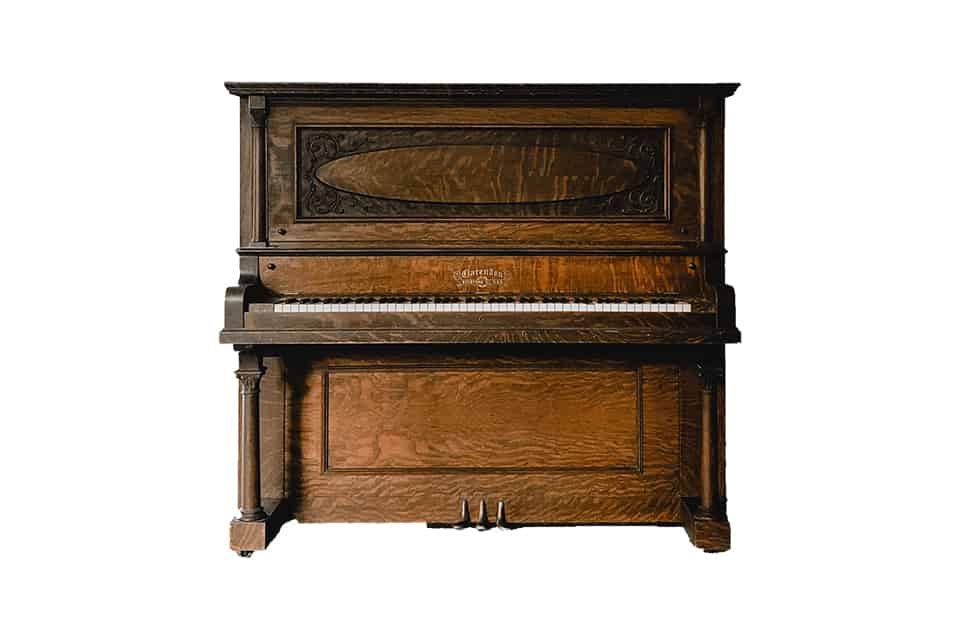
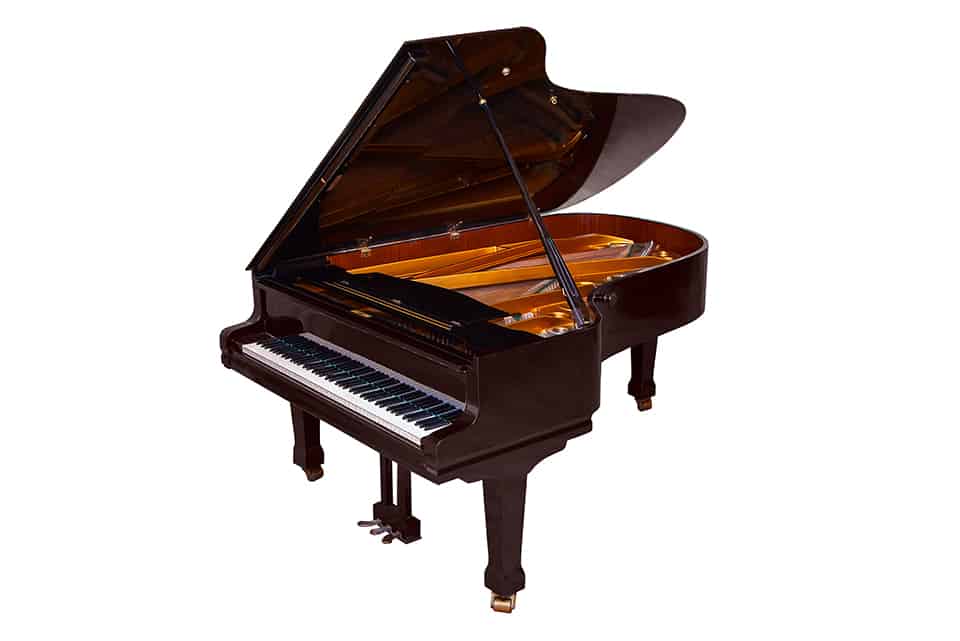
The differences between an upright piano and a grand piano are not merely aesthetic. First of all, the biggest technical difference is that the strings in an upright piano are strung vertically, while those in a grand piano are strung horizontally, as in a harpsichord. This, of course, makes an upright piano more space-efficient—not everyone has enough room at home for a grand piano.
The design also affects how the instrument plays. This is because, on an upright piano, springs return the hammers to their original position after they strike a key, whereas on a grand piano, they fall back automatically due to gravity. As a result, a grand piano can produce significantly more keystrokes per second.
At the same time, a grand piano offers a richer tone and significantly greater dynamic range than an upright piano. The sound is more powerful and, at the same time, has a smoother sustain. Overall, then, a grand piano offers even greater expressive possibilities.
Grand pianos are ideal for ambitious pianists. They are generally not yet necessary for beginners. However, if you have the space and the financial means, and you know that your enthusiasm for the instrument will last, you can, of course, buy a grand piano right from the start. Grand pianos are available starting at around €10,000.

Electric pianos, or digital pianos, are keyboard instruments in which the sound is produced digitally rather than mechanically. This means that when a key is pressed, a sound that was previously recorded is played back digitally. Digital pianos are less expensive to purchase than acoustic pianos and do not need to be tuned. This makes them particularly popular as instruments for beginners. In addition, they can be played with headphones, so neighbors aren’t disturbed. This is particularly beneficial for piano students who, for example, work full-time and can only practice at times when playing the piano loudly might not be the best idea for maintaining good neighborly relations. Incidentally, there is also a2017 ruling by the Munich Labor Court stating that playing a musical instrument generally does not constitute an unreasonable noise nuisance.
Upon closer inspection, the argument that digital pianos take up less space is a fallacy: Digital pianos also have 88 keys, so their width is roughly the same as that of acoustic instruments. In terms of depth, the digital piano is slightly narrower. The only significant difference is in height. However, the instrument is usually placed against a wall. The difference in height therefore makes little difference, so that with similar width and depth, a digital piano does not actually take up less space than an acoustic piano.
In terms of sound, newer digital pianos are quite good these days. Still, they don’t quite measure up to an acoustic instrument. Despite weighted keys designed to mimic the “feel” of an acoustic piano, the playing experience is also quite different. Digital pianos don’t provide feedback when the keystroke is too hard. While the volume varies, the digital piano doesn’t differentiate in terms of sound quality, since it’s simply a recorded sound. That’s why a digital piano provides significantly less accurate feedback on playing technique than an acoustic instrument.
All in all, an acoustic piano is always the better choice. New acoustic pianos start at around €3,200. A good digital piano costs significantly less than an acoustic piano—so if you’re on a tight budget, a digital piano is a perfectly good choice to start with; however, you should still prioritize quality. You should also consider whether renting an acoustic instrument or opting for a rent-to-own plan might actually be the better option.
Another excellent option is pianos equipped with a silent system, which can be played either “normally” (acoustically) or electronically. The silent technology, originally developed by Yamaha, allows the sound to be output through headphones or a stereo system, while the piano can be muted using the middle pedal so that only the digital sound is produced. Other companies, such as Kawai and Bechstein, now offer similar systems as well. Retrofit silent systems are available from PianoDisc. With a silent system, you can play the piano at any time of day or night without needing an electric piano, and you no longer have to worry about disturbing your family or neighbors while you play.

However, acoustic instruments with a silent system are significantly more expensive than digital pianos. Digital pianos are therefore particularly appealing to students who are just starting to learn to play the piano and cannot afford to purchase an acoustic instrument. That said, from our perspective, there are better options, such as a rent-to-own arrangement for an acoustic piano that can be equipped with a silent system if needed.
If you do decide to buy a digital piano, you shouldn’t choose the absolute cheapest model. Digital pianos starting at around 800€ typically already feature weighted keys, improved sound quality, and a more authentic playing experience. As the price increases, the simulation of an acoustic piano becomes increasingly realistic. High-quality digital instruments are available starting at around 1,500€.
If you’re still unsure whether you’ll stick with your new hobby, you can also choose to rent an instrument. Some piano stores offer a rent-to-own option. This means your payments will be applied toward the purchase price if you later decide to keep the instrument.
For anyone who’s hesitant to make a large initial investment, renting a piano is a very attractive option. If you change your mind and no longer need the piano, your only investment will have been the rental costs—plus the cost of transporting the instrument. You can rent a piano for as little as €49 a month while still enjoying the quality of an acoustic instrument. A good digital piano starts at around €800. However, the depreciation when reselling a digital piano is quite high. Consequently, if you or your child decides to give up this new hobby, the additional cost of renting is modest compared to the loss you’d incur by selling a digital piano. Renting is therefore a great option for anyone who wants to test the waters first but doesn’t want to miss out on the benefits of an acoustic piano.
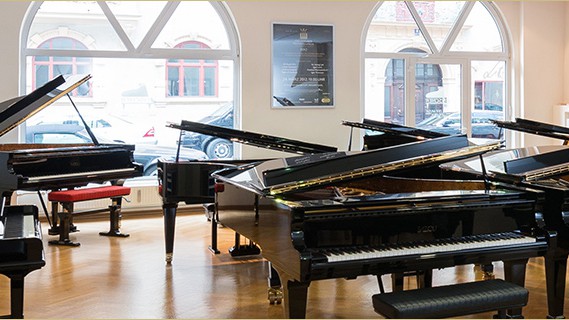
Klavier Hirsch GmbHis a traditional family-owned business founded in 1888 and now in its fourth generation of family ownership. Klavier Hirsch sells new and used upright pianos, digital pianos, and grand pianos from various manufacturers, particularly Kawai, Sauter, Schimmel, Blüthner, and Bösendorfer. In addition to sales, Klavier Hirsch offers support and service for all aspects of piano care. This includes repairs, maintenance, and tuning, as well as consultation and the sale of accessories. These range from piano benches and lighting to modern air humidifiers, dehumidifiers, and climate control systems. Instruments can also be financed through Klavier Hirsch. Hire purchase and rental options are also available. Thanks to its in-house master workshop, the store can, for example, install new pianos into old ones or retrofit silent systems.

The long-established companySteinway & Sonsprobably needs no introduction. For 160 years, the company has been building excellent grand and upright pianos, which are now manufactured in New York and Hamburg. In addition, there are the “Boston” grand and upright pianos, which are manufactured in Japan, as well as the “Essex” grand and upright pianos, which are manufactured in China.
At Steinway showrooms—one of which is located in downtown Munich—you can try out the instruments and receive comprehensive advice. Repair and tuning services are also available. The Steinway showroom offers financing options as well as rent-to-own plans.

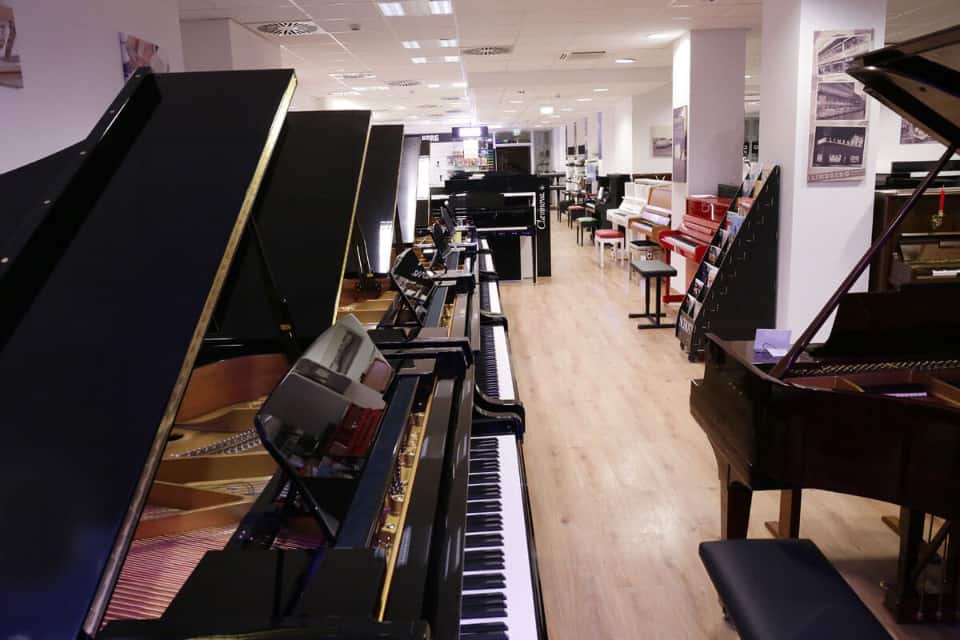
TheHieber-LindbergMusic Store offers a “world of keys” spanning 500 m2, where customers can try out the available instruments at their leisure. The selection includes both new and fully refurbished instruments (digital pianos, upright pianos, grand pianos) from a wide variety of manufacturers. Among others, instruments from Steinway & Sons, Grotrian-Steinweg, Bechstein, Schimmel, Roland, Casio, Kawai, Yamaha, and many more are available. Hieber-Lindberg thus offers a wide selection aimed at both beginners and professional musicians. While the emphasis used to be on digital instruments, the focus has shifted toward acoustic pianos with the opening of “Tastenwelt.” If necessary, the instruments can be equipped with silent systems for quiet playing. Of course, you’ll receive personalized and expert advice on-site—and the piano builders from the Hieber-Lindberg network will be happy to continue supporting you even after your purchase.
Do you need further advice?
We usually reply within 48 hours.
We usually reply
within 48 hours.